
|
Home |
Schedule |
Recordings Etc. |
About us |
Links |
Mole Records
The KGB pages are maintained by Dave Bartley © 2009 Mole Records |

Contra-intelligence
Fiddle tunes infiltrated by foreign agents
|
Home About us Schedule and news Recordings and books Contra-intelligence Volga Notions In from the Cold The Red Light of Evening KGB Tune Dossier KGB Tune Dossier Vol. 2 Links Mole Records E-mail us |
|
Read reviews:
Contents and Soundclips
All selections traditional unless otherwise noted.
|
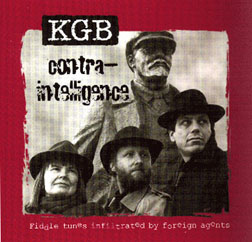 |
Contra-intelligence captures the essence of KGB--distilling the long, improvised medleys of live dances into tight arrangements. The album showcases the band's musical passions, from their hallmark interpretations of New England, French-Canadian and English tunes to the Balkan-Celtic Trip to Sofia, a hip-hop Irish number, a Baroque-inspired fugue, a Brazilian choro and a silly polka set. There are waltzes "to die for:" Julie's dreamy Call It A Night, Dave's romantic The Merry Waltz and meditative The Clock Stopped. |
Order the CD or the MP3s via CDbaby using this button: 
"I'm a hardcore musician myself and play in an eclectic string band. It takes a lot to turn my head, but this CD is the most delightful, exciting thing I've heard in years. Not only was I impressed with the superb musicianship and tight arrangements, the wry humor and fresh mix of musical styles makes for a fun, energizing listen." - Susannah Ravenswing
"I *particularly* think The Clock Stopped is maybe the most beautiful piece I've ever heard -- beautiful in composition, development, arrangement, everything." - David Wiesler
I am enjoying the KGB CD tremendously! What great spirit you folks have when you play, and wonderful harmonies and arrangements. Terrific! - Michele Eaton
Great energy, interesting arrangements, wonderful tunes! I put it on for my first listening while I was doing work at my desk and I kept finding that I was just sitting there absorbed. - Andrea Hoag
The originals are gorgeous, spirited and delightful. - Susan Madden, KBCS
It's high energy, it's romantic, and it moves me to tears. I love the new KGB CD!!! I hope that there will be more to follow. - Janet Chappell
Dramatis Personae:
- Julie King - piano, percussion
- Claude Ginsburg - violin, concertina, viola, mandolin, feet, Nevamar(tm), jug, percussion
- Dave Bartley - mandolin, guitars, cittern, tenor banjo, prim, tambura, percussion
- Additional percussion on Chorinho: Barry Foy, Maya Johnson
- Whistling on U Shest Koraka: Tom Deering
The Missing Liner Notes:
After some debate, we decided not to provide notes about each
tune on the album inside the CD. Instead, here they are:
Trip to Sofia
The Reconciliation
For about as long as Dave has been playing music for contradance, he has also been playing music of the Balkans. Trip to Sofia is an attempt to merge Bulgarian and Irish styles, though the treatment has elements of Klezmer and Israeli folkdance. It's a big world out there. One time through the Irish Reconciliation provides A major contrast to the hijaz Sofia.
Crimea River
West to Alaska
The first tune was doomed to have a dumb name. First Dave called it And Back, intending to follow Trip to something with it, but it kept sounding better before than after things. KGB learned Andrea's lovely West to Alaska during one of her visits to here in Seattle, her previous stomping grounds.
Call It A Night
At the end of a jam session a while back, Seattle violinist Elisabeth Alexander said, "Let's play a waltz, then call it a night."
Radstock Jig
Dear Tobacco
Fugue
Claude learned Radstock Jig (which is much a Jig as Chorus Jig is) while Claude and Julie were touring in England in 1994. Dear Tobacco has been kicking around in Claude & Julie's repertoire since before KGB. Dave has been itching to write a little fugue on a contradance tune subject, and the first two bars of Dear Tobacco seemed a good choice (this is a very little fugue and no doubt Fux would find lots of counterpoint errors).
Pork Barrel Polka
Bottom of the Barrel
This was a self-commissioned work to fill a shortage of new polkas and tunes suitable for silly dances in KGB's repertoire. It started out as a cross between English polka and Strauss, but ended up sounding like Spike Jones.
Chorinho 'O Tangeiro'
Claude's penchant for Brazilian music emerges in full force here. He plays mandolin on this one while Dave backs up on guitar and (of all things) a prim, the most diminutive Croatian tamburitsa instrument. (note the different sound of Claude's Gibson A model on this tune versus Dave's Flatiron F model on the other tunes).
Contra-intelligence
Claude got the piano right hand riff from a Junior Walker harmonica riff he heard on the radio on the road home from a rehearsal. He then threw together a backdrop using a 4-track, tried Julia Delaney on top of it, and the rest is history. Dave gets the blame for the title.
Leather Egg
Highlander's Farewell
Claude claims that the tune for Leather Egg was running through his head not long after having seen the movie Alien (not his type of movie, by the way) Dave brought Highlander's Farewell into the band after hearing the fine version by Moving Cloud Orchestra (and not after seeing Highlander).
The Merry Waltz
Dave wrote this for his wife, Mary. Before she met Dave, Mary had been engaged to a Seattle-area musician, Mel Webb, who died in a hiking accident. Mel had written a waltz for her called The Happy Waltz, which they performed together at the Northwest Folklife Festival just before he died. The name Happy Waltz comes from translating Mary's family name, DeFelice from Italian. After Mel's death, the music for The Happy Waltz was lost in the file drawers full of music Mel left behind. Mary remembered that it had been in A minor, and The Merry Waltz was born soon thereafter from a couple of ideas Dave had been kicking around. (The music for the Happy Waltz turned up not long after, too)
Quebec Reel
Reel de Montreal
Festival du Voyageur
Levis Beaulieu
These are Quebecois tunes, all but the first one long-standing contradance and jam session favorites in the Northwest. Quebec Reel we got from Steve Trampe, who learned it from Sue Sternberg. This is an edited-for-listening version of a typical French Canadian contradance medley (usually 2 or 3 tunes and several more times through each).
The Clock Stopped
The second theme of this had been floating around in Dave's head for a while until it was paired with a Gymnopedie-inspired first theme.
Round About Our Coal Fire
Morgan Rattler
Each of the three of us plays in a different English Country dance band, so playing a Playford tune was a natural. Dave's original notion of giving it an Afro-Cuban treatment disappeared but left behind a shadow of 3-on-2 and 4-on-3 cross-rhythms. Claude brought Morgan Rattler, a 3 part Irish Jig, into the band.
The Other Road to Durham
George Booker
Interlude
Lexy McAskill
U Shest Koraka
The Growling Old Man and The Grumbling Old Woman
Also known as the Mega-Medley, this was the closer for our first concert, played in Yakima in eastern Washington. It is two contradance medleys glued together by the Interlude taken from Julie and Claude's Contra and Blue album.
Claude wrote the first tune shortly after he, Julie and Mike Richardson got lost on the way to Durham, New Hampshire. We got George Booker from Mike.
Lexy McAskill was learned from Johnny Cunningham when he played at Fiddle Tunes a few years back. It was written by John Napier McAskill (Thanks Gordon Potts for this information). U Shest Koraka (Sh is really S with a v on top, but I'm keeping this ASCII) came from an LP of Serbian brass band music. The last tune, whose title has myriad variations all involving an elderly couple, is a true warhorse that has continued to be fun to play after all these years.